Unknown's avatar

Lode Storm – 7 Day RTS Compo

I have for the last few days been squinting in the dark at my monitor in the early hours of the morning.  I couldn’t resist entering this months Mini Ludum Dare since the challenge was to make a RTS game in 7 days.  An RTS game is something that I have always have wanted to make, from a technical point of view as much as anything.  I spent countless hours playing C&C, Dune2 and dungeon keeper in my childhood and the AI in this genre in particular always fascinated me.

My initial research on RTS AI directed me to some great papers written about potential fields and their use in the RTS genre.  This is a method I had read about previously, but these papers really gave me the vision for just how powerful they could be.  The papers can be found a the bottom of this great article at AIGameDev. http://aigamedev.com/open/tutorials/potential-fields/.

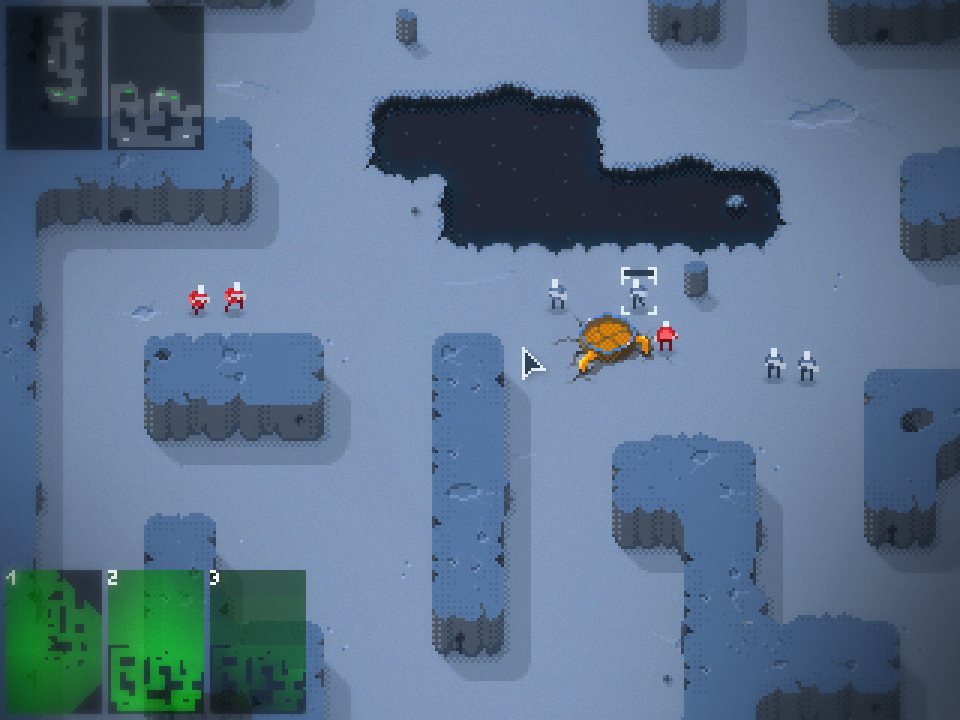
All the programming I had done on my framework is now being tested to the limit for this project, and so far (touch wood) it hasn’t failed me. Additionally, I am particularly proud of my efforts on this project because I have made all of the graphics myself from scratch and this really is my most complete game to date, since I usually get sidetracked while working on the technical details of a project.  Provided below is a screenshot of the current work in progress.  Several potential fields are being displayed for debugging by eye in the lower left corners.  Top left shows the fog of war maps for both the human player and the AI player respectively.

lodestorm

Unknown's avatar

Binding Tiny C Compiler

Years ago I found a interesting library called TinyCC, which provided a simple and small C compiler with one major twist…  it can be embedded inside another application.  Because of this, a program can compile new functions for itself at run time and call them using function pointers.  In a sense it can be used like an immensely powerful scripting language, with the benefit that there is no speed hit due to interpretation or emulation.  Its weakness as a scripting language is that you have to account for portability and security problems due to the execution of these ‘scripts’ running as native code on the host processor.

So far, I have used TinyCC for a few projects in the past and recently in a texture generator as well as my text adventure engine.  The reason for this post however, is that TinyCC is not the most intuitive thing to embed into a windows application, so I wanted to take a moment to explain one clean method to do so.

There is no static library for use with visual C++ so that option is out, however since a fully compiled DLL file is included in the download package, it seemed that it would be easiest to dynamically link the DLL through code at run time.  This requires loading the DLL and requesting all of the functions that are exported from it which is a fairly easy operation on any platform and generally differnt OS’s have much the same interface for doing so. The only tricky part is actually specifying all of the annoying function pointer casts correctly during binding.

Without farther talk, here is some straight forward code to load TinyCC and bind the interface for you. Which I hope it should all be fairly straight forward and easy to understand.

libtcc_bind.h

libtcc_bind.cpp

Unknown's avatar

Fault Line Algorythm

A few days ago the “More OpenGL Game Programming” book was posted through my letter box.  This book is awesome, and I have so far loved reading it.  At some point there was a description of the “Fault Line” algorithm for terrain generation, which really managed to grab my attention, as I have been particularly interested in procedural generation recently.  However, I realized that I have read about this method before on the great Hugo Elias website, as part of an article which can be found here.  At first I dismissed the algorithm when described by Hugo since he presents it in the context of spherical landscapes, and in this case the algorythm seemed computationally horrible. This book applied presented the algorithm in 2D space at which point I kicked myself for not realizing that it can also be applied in 2D space.

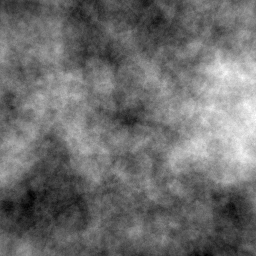
The fault line algorithm is generally employed in the first stages of height map construction during terrain generation.  The algorithm is extremely simple and a mode complete explanation can be found here.  The basic idea, is to generate two points that form a line that lies across the texture with a random position and orientation.  Each pixel of the texture that lies on the positive side of this line can be incremented a tiny amount.  After hundreds of iterations nice cloudy fractal noise is produces, that in theory should be free from any pattern or statistical bias.  This of course is only true if care is taken while constructing various elements of the algorithm.

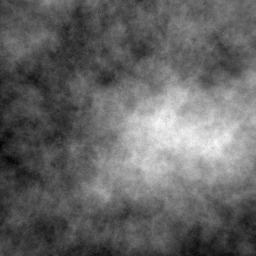
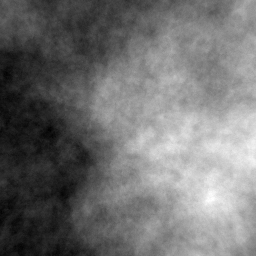
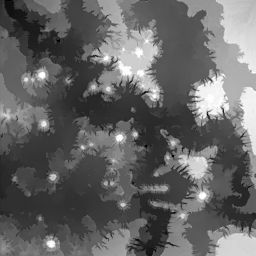
Looking at the example images and source provided by the book however I realized that the terrain generation was sub optimal because statistically the fault line start and end points are biased towards the corners of the texture map.  I fixed this using a method I described in a previous post, by discarding fault lines that lie outside of a circle encompassing the texture space.  The results are pretty great actually, and what you see below is the output from four consecutive runs of my generator program.  These noisy maps will serve as a great base for farther manipulation, resulting in a terrain generator.

Image  ImageImage Image

Unknown's avatar

THUMB Disassembler

I was recently searching through my hard drive looking for examples that might highlight my love of low level programming, and I present here one such project which is a good example of this.

THUMB is an instruction set that was added to some ARM processors as a way to reduce code size, which is advantageous as ARM typically finds use in very constrained devices.  The processor can switch between two operating modes at the request of the program, switching from decoding ARM instructions to smaller THUMB instructions.

I found THUMB particularly interesting since the instruction set is clean and simple and it might make a nice basis for a virtual machine to execute programs written in it.  My idea was to use programs written in C and compile them to THUMB and then execute them in a virtual machine, the entire process serving as a powerfully scripting system for games.

Ultimately, I switched to a MIPS processor as my basis for this project, but I still got as far as making a THUMB disassembler.  I should point out that this was the first disassembler I ever wrote so it marks a large mile stone for me.  Since then I have made a very nice MIPS disassembler using much of what I learned on this project.  The code for the THUMB disassembler can be found here:

thumb_disassm.cpp

To test a disassembler there needs to be something to feed it.  For that purpose, I compiled a small program in GCC targeted for the THUMB instruction set.  The program is listed below, and is just a nonsense program designed only to be valid so as to generate some instructions:

Continue reading

Unknown's avatar

Let the adventures begin

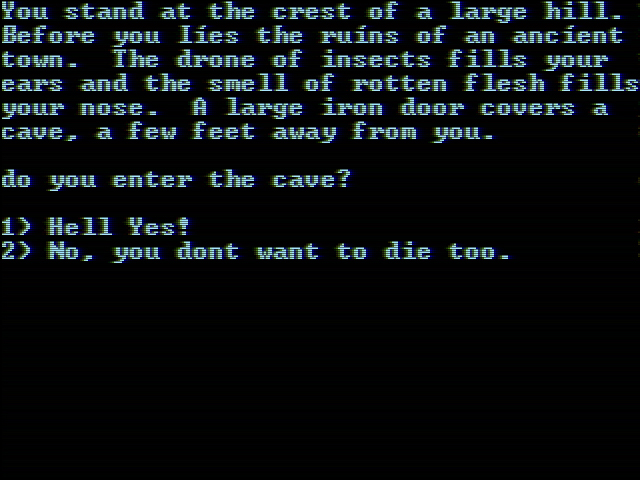
Recently my girlfriend asked me if I would help her program a text adventure.  She has wanted to learn the program in C for a long time and also has been looking for a project we could work on together.  I thought this was an awesome idea, so I set about programming a basic shell of an adventure engine for her to work with.  I wanted to take the load off her so she can focus on developing the story rather then dealing with blitting, messaging, etc.

I managed to pack the entire DOS font of 256 characters in to 3k of space and embed it into the program, which was pretty cool, so each bit encodes only one pixel.  I could perhaps have achieved more using RLE but there really isn’t any need to go that far.

My library emulated a console screen of 40×20 characters.  It has a cursor that can be moved, text and symbols can be written to the screen and it handles user input,  so in short, all of the basics for a text adventure.  There is no scrolling implemented yet however since that didn’t seem necessary.  Conceivably an awesome rogue like could be easily written with this library.

Plain text however just seems too digital and static.  I wanted something more like and old analogue CRT monitor with a little too much interference, and misaligned deflection coils.  So a second achievement was to finally get around to writing my ‘ghetto blur’ as suggested long ago for my yet unnamed dungeon game.  I managed to do this efficiently using some cool tricks, using only ANDs, ORs and shifts.  It looks fairly retro and below you can see it for yourself, however the magic is seeing it animated as it subtly flickers and wobbles.

Image

Unknown's avatar

Ambient Occlusion

I spent my morning programming a small ambient occlusion generator for height maps and the quality of the output is surprisingly nice.  In the picture below, 2048 random rays are cast from the center of each pixel out towards the hemisphere.  Each pixel represents the ratio between rays that hit other locations of the height maps and those rays that are clear of all other terrain.

Several methods were used to improve the quality.  Again at all stages, I use sub pixel accuracy, using bi-cubic interpolation in all calculations.  Random rays are generated that maintain a strong random distribution over the entire hemisphere.  This is accomplished by setting a rays x and y components to a random value, between -1.0f and 1.0f.  The z component is set to a random value between 0.0f and 1.0f, to ensure it rises out of the terrain.  The statistical trick here is to discard the ray if it has a magnitude > 1.0f, and try to generate another random ray.  Once a ray is found with a magnitude of < 1.0f it can be normalized and then used.  This method was described in “Texturing and Modeling: A procedural Aproach”.

Image

Image

Unknown's avatar

Hydrolic Erosion

I have spent most of today and yesterday trying to simulate a basic form of erosion due to the action of water washing away at the surface of a height map.  To generate convincing, earth like procedural terrains, I really believe this is a phenomenon that needs to be modeled.  I devised and implemented two approaches to model this, the first involving something similar to pressure maps or heat maps, however it was too unstable to be really useful.  The second method is much more simple at its core however unfortunately not as fast as my first method.

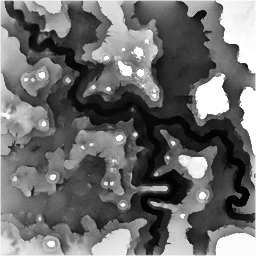
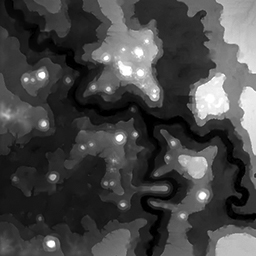
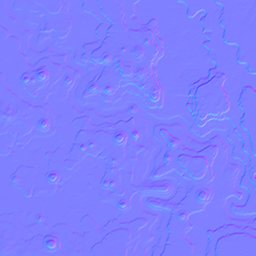
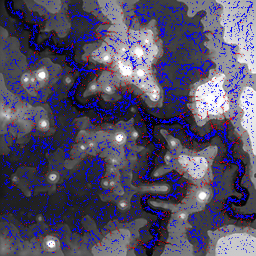
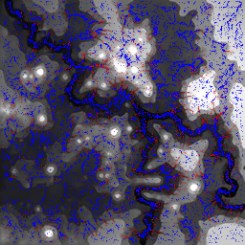
I store an array that holds 32768 (2048*16) particles, each initially placed at random across the surface of the height map.  Each particle has a location, a velocity, and also a mass parameter.  Each particle gains an acceleration that guides it down the height map.  This is achieved by sampling the gradient underneath each particle in a process exactly the same method as that which is used to generate normal maps from height maps.  Figure 1 shows the height map and Figure 2 shows the corresponding normal map that can been calculated from it.  I did in fact take things one stage farther and allow the position of each particle to have a sub pixel accuracy so that the gradient can be calculated at sub pixel accuracy too using bicubic interpolation.  As particles run down the height maps, it is inevitable that their motion will cease at some point as they come to rest.  I detect this when the magnitude of their velocity is close to zero, at which point they are given a random location, with a bias towards high areas of the height map providing a weak model of evaporation.  When a critical speed is reached for any particle then it will lift material from its position on the height map and add it to the particles mass parameter.  When a particle lifts material, the height map is written to, again using bicubic interpolation, to reflect the loss of this material.  Figure 3 shows a visualisation of the particle system during simulation.  Particles shown in red are currently moving fast enough to lift material from the height maps surface.  When a particle comes to rest and has been flagged to be moved by the evaporation process, all of the mass that it has accumulated is first deposited at its current resting point.  Since the gradients are recalculated for each particle during its update, these two processes that change the height map will influence particles that later may follow a similar path.  Thus commonly used paths will be eroded, reducing their height gradually.  In figure 4, we can see the process after around 20 seconds of simulation.  Notice that deep eroded paths can be found moving from areas of high elevation to areas of low elevation.  Also notice that initially there was a large black split running through the middle of the map, representing some canyon, or a large river.  The process of erosion has deposited material in this space, raising its height significantly.

The simulation time could be considered significant if this technique was to be embedded in a games level generator, but the results seem initially very encouraging.  There are many parameters to play with however, each giving different results, so much more experimentation in this regard needs to be done.  Another technique that needs to be explored to compliment this work is a method to detect which regions of the map should be submerged by water.  After all, this is not much use unless we can also have nicely animated water in the correct places.


Figure 1.

The height map used in the demonstration.

Image

Figure 2.

A normal map generated from the above height map, demonstrating a method of determining the gradient by taking the vector cross product of tangent and binormal vectors.

Image

Figure 3.

Visualization of the particles in action.  Particles shown in red are moving fast enough to lift material from the terrain.
Image

Figure 4.

The resulting simulation of crude erosion of the height map after around 20 seconds in the simulator.  Notice the deposit of material that begins to fill up the lowest points in the map.

Image


Figure 5.

Here the erosion model is applied to a smooth gradient to observe the effect of many random particles all moving together to create successively larger channels the deeper down the surface they run.

gradient

Unknown's avatar

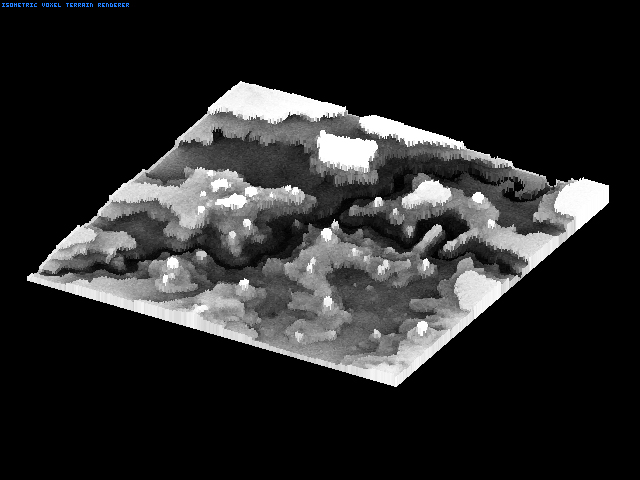
Voxel Heightmap Rendering

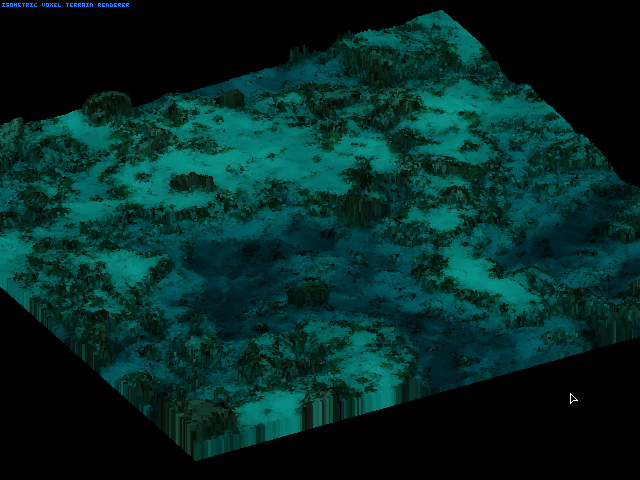
I spent most of yesterday developing and implementing a really unique voxel renderer.  I have so far only heard of ray casting methods for drawing voxel landscapes, but the approach I came up with is radically different.  The performance is really great however, and is comparable to any ray casting approach.  I don’t know whether to keep the algorythm under wraps just now, since I think it could have a lot of potential.

Currently the rendering is only isometric, but it should be possible to modify it for perspective rendering too if I sit down with the math.  There is no pre computation for this method so the height map and terrain texture can all be updated on the fly, opening up lots of amazing possibilities.  Zooming, rotation, and tilting are all free performance wise since they are fundamental parts of the algorithm.  The terrain resolution is also independent from the performance of the algorithm surprisingly, so there is no penalty for a very detailed landscape.

Over the next few days I really want to push this technique and see if I can squeeze more from it.  I have plans to implement ambient occlusion and dynamic hemispheric lighting.  Also dynamic light mapping could be integrated.  The possibilities are really inspiring.

screenshot

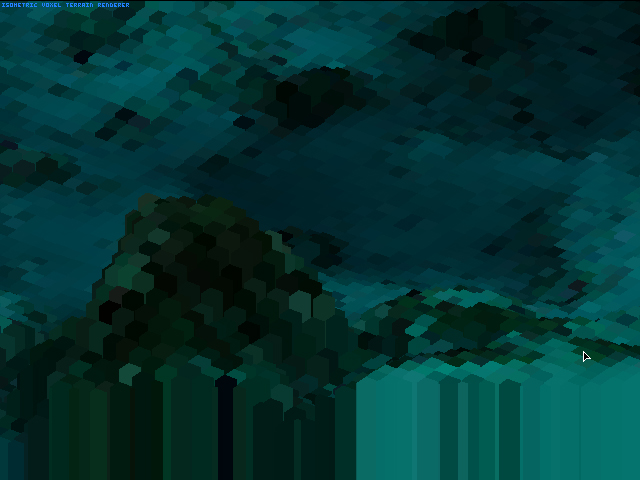
Here is an extreme close up where you can see the individual voxels.

closeup

Unknown's avatar

2D Instant Radiosity

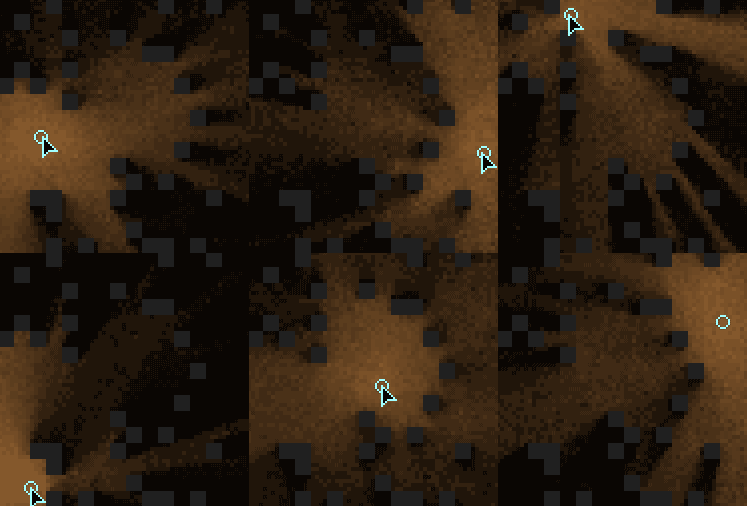
Since I am experimenting with my new ray casting code, I decided it might be worth trying to implement a 2D version of the instant radiosity algorithm.  The results are very pretty.

Radiosity

The strategy is really simple.  From the light source, you cast out rays in several directions, and store the intersection points.  In the above capture, there was 64 of these points, but its more reasonable to have less, since there is an big performance penalty the more you have.  The next step is to iterate over all the tiles on the map performing a ray cast from the center of the tile, to each of these initial sample points that we captured.  The percentage of hits we gather determines the brightness of the tile, the more unblocked ray casts then the brighter the tile.  Simple as that.

RadiosityNoiseLow

An unfortunate aspect of the vanilla algorithm is that it produces many noticeable blocky artifact which can be quite off putting to the overall effect.  A solution I propose to this problem is to add jitter into the algorithm.  For each of the ray casts from a tile to one of the irradiance samples we add noise to the position of the irradiance sample.  This noise actually improves the overall accuracy of the algorithm which is a strange phenomenon.  It also looks much more pleasing to the eye in my opinion.